Asia · Central Asia
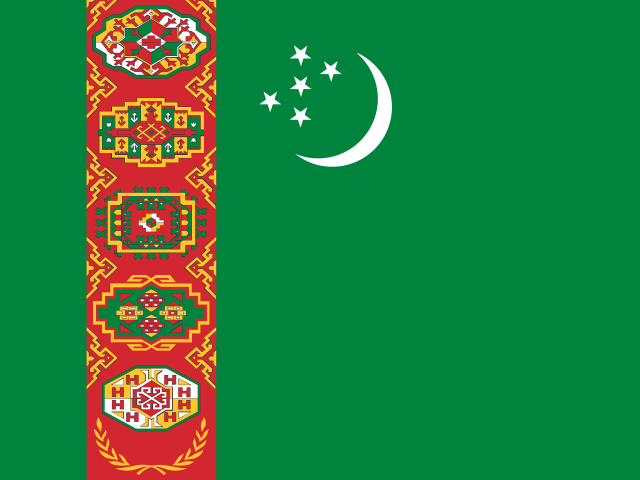 Turkmenistan
 is among the most closed and authoritarian countries in the world. Independent travel barely exists: tourist visas are hard to obtain and usually require a guided itinerary. Ashgabat, the white-marble capital, has the country's best accommodation, though currency controls make real costs hard to judge. Crime is very low. The internet is among the most censored anywhere, with heavy blocking of international sites and services. This is an unusual guided trip, best in spring or autumn, and not a place to live or work.
Nomad quick facts
$2330/mo
$3730/mo
—
1.903 (#86 of 190)
Limited
Apr–May, Sep–Oct
Not available
37.8 / 100
Score breakdown
Unusual sights such as Ashgabat's marble architecture and the Darvaza gas crater, very low crime.
Guided tours effectively mandatory, heavily censored internet, difficult visas, no independent travel.
Cost of living in Turkmenistan
Turkmenistan has relatively low local costs for food, accommodation and basic services, although currency controls and exchange-rate differences can make the real cost to visitors difficult to assess. Ashgabat is the main urban center and offers the country's widest range of accommodation and amenities. Travel restrictions and limited independent tourism are a much bigger consideration than the underlying prices.
Estimated monthly cost
Single
$2,330/mo
Couple
$3,730/mo
Cost score inputs
Livingcost
61/100
WB PLI
23.9
Score blends a nomad-realistic monthly cost estimate (built from livingcost.org data, adjusted for short-term nomad spending like furnished housing, coworking, and eating out) with the World Bank's Household Consumption Price Level Index, a broader cross-country cost benchmark. Countries without World Bank price-level data are scored on the livingcost estimate alone. Prices displayed in USD.
The nomad cost estimate reflects a realistic single/couple monthly budget, not a bare local cost of living — actual spending still varies with lifestyle and location within a country.
Sources: livingcost.org · World Bank Household Consumption Price Level Index · Independent nomad cost estimates
Internet in Turkmenistan
Turkmenistan is lacking official internet performance data, while heavy state censorship and widespread blocking make accessing many international websites and services difficult for digital nomads.
Blends download speed (Ookla Speedtest Global Index) with upload speed and latency (Cloudflare Radar). Speeds are scored between 10 Mbps (0) and 200 Mbps (100); latency counts the opposite way — lower is better. A missing metric doesn't penalize a country, it's scored on whatever data is available.
A national average — city and neighbourhood speeds vary, especially outside major hubs.
Get an eSIM for arrival →Sources: Ookla Speedtest Global Index · Cloudflare Radar
Safety in Turkmenistan
Turkmenistan has very low crime, but it's one of the most closed and authoritarian countries in the world, with heavily restricted internet access and very limited independent travel; the barriers for nomads here are bureaucratic and political rather than safety-related.
Global safety rank
#86 of 190
Peace Index score
1.903 (lower = safer)
Blends three published safety indices: the Global Peace Index, the WJP Rule of Law Index (Order & Security factor), and the Gallup Global Law and Order Index. Places the Global Peace Index doesn't cover use our own estimate, based on regional peers and crime data. Each is rescaled 0-100 and combined with weights favoring GPI and Gallup slightly over WJP. Not every country is tracked by all three — the blend adjusts to whichever are available (weights are renormalized) rather than penalizing a country for a missing source, though a country tracked by fewer sources carries lower confidence.
As this is national average data, be aware that safety varies significantly by city and region within a country.
Get nomad insurance →Sources: Global Peace Index (Institute for Economics & Peace) · WJP Rule of Law Index (World Justice Project) · Gallup Global Law and Order Index
Tourism & infrastructure in Turkmenistan
Ashgabat's surreal white-marble, gold-statue cityscape and the flaming Darvaza "Gates of Hell" gas crater make for one of the most unusual guided trips on Earth. This is one of the most closed and controlled countries in the world, though, with no independent travel or nomad route whatsoever.
English Proficiency Index
456.0 (75 out of 106)
Within-city transit
Limited
Between-city transit
Limited
Arid desert; very hot, dry summers and cold winters.
Best months: Apr–May, Sep–Oct
Turkmenistan's transit centres on Ashgabat, which has a public bus network and very cheap state-subsidised taxis, though the grandiose marble city is spread out and car-oriented, with no metro. Intercity travel uses buses, a slow railway and domestic flights across the desert. Movement can be constrained by the authoritarian state; the monumental capital is walkable in parts but distances are large.
A weighted blend of published indices: the World Economic Forum's Travel & Tourism Development Index (weighted highest — the strongest predictor of appeal), Numbeo's Quality of Life Index, the World Happiness Report, Gallup's day-to-day enjoyment data, the EF English Proficiency Index, and a public transit assessment covering both within-city and between-city transport. Not every country is scored on all six — the blend adjusts to whichever are available rather than penalizing a country for a missing one.
Sources: WEF Travel & Tourism Development Index · Numbeo Quality of Life Index · World Happiness Report · Gallup · EF English Proficiency Index · Public transit assessment
Turkmenistan visa and entry rules for digital nomads
Tourist entry — USA passport
Visa required — 10 days (with LOI)
Tourism Visa Note
Given the current security/political situation, standard visa process may be unreliable. Consult government travel advisories directly.
Digital nomad visa
No dedicated digital-nomad route
Other long-stay options
Turkmenistan is one of the hardest countries to enter: tourist and business visas both require a government-approved Letter of Invitation (and tourists are effectively obliged to travel with a licensed guide). The one exception travellers rely on is the 3–5 day transit visa, granted without an LOI if you can show onward visas for a neighbouring country — popular for overland crossings. There is no long-stay or nomad route; independent, unescorted stays simply aren't permitted.
Visa and entry requirements can change. Check the latest information from official government sources before travelling; eligibility, documents and permitted activities depend on your nationality and personal circumstances.
Tax & residency in Turkmenistan
Tax-residency timing
183 days or more in a tax year
How the day count works
Physical presence counted in the tax year; transit days are excluded
Other residency triggers
No other individual residence trigger verified beyond presence
Remote work before residence
May be taxable. Turkmen-source employment and service income may be taxable for nonresidents
If you become tax resident
Residents are generally taxable on worldwide income; nonresidents on Turkmenistan-source income
What this usually means for nomads
A stay of 183 days or more in a tax year can establish residence and bring foreign income into scope. Work performed in Turkmenistan may be taxable before then. Local employment, workdays or an extended stay increases exposure.
Tax rules can change and depend on your residency status, income structure, time spent in the country and applicable tax treaties. This information is general only and is not financial or tax advice. Consult a qualified tax professional before relying on it.
Top cities for nomads in Turkmenistan
Ashgabat is the only real base and is tightly controlled. Mary is the gateway to the ancient Silk Road ruins of Merv, and Turkmenbashi is a Caspian port with a resort zone.
Capital & largest; surreal white-marble city; the only real base, but highly controlled.
Caspian Sea port & Awaza beach-resort zone; seaside, developing tourism.
Gateway to ancient Merv (UNESCO Silk Road ruins); desert history.
Northern city near Konye-Urgench ruins; remote, off-the-map.
 North Korea
 Eritrea
 Sao Tome and Principe